Monday, May 29, 2006

See, Hear, Think: 2 Shapiros Abound


Busy days are ahead for cousin Neil Shapiro and me, Elaine (Shapiro) Soloway: On Friday, June 2, 2006, from 6-10 p.m., Neil is a featured artist at Gallery 203, 1579 N. Milwaukee, Ste. 203, Çhicago, 773-252-1952. If you haven’t viewed Neil’s wonderful work (see above), you can check out his website, and attend the opening, too. The show runs through June 25, and wine and cheese awaits reception guests on the 2nd. Stop in.


On May 31st, Vanessa Bush, a talented reviewer for Chicago Public Radio’s “848” interviewed me re: THE DIVISION STREET PRINCESS. The WBEZ radio program will air during Steve Edward’s hour, sometime between 9-10 a.m. on Thursday, June 1. Luckily for me, the station posts episodes on its website, so you'll be able to hear the interview later that day, and forever after. Tune in.


Finally, I’ll be part of a panel at the Printers Row Book Fair on Sunday, June 4, 2 p.m., at the Nelson Algren Stage, Harrison St. between Dearborn and Plymouth, Chicago. Authors Faith Sullivan (GARDENIAS) and Chris Burks (NEECEY'S LULLABY) will join me in a discussion moderated by Mary Davis Fournier, project director with the American Library Association’s Public Programs office and a member of the Printers Row Book Fair advisory committee. Come by.

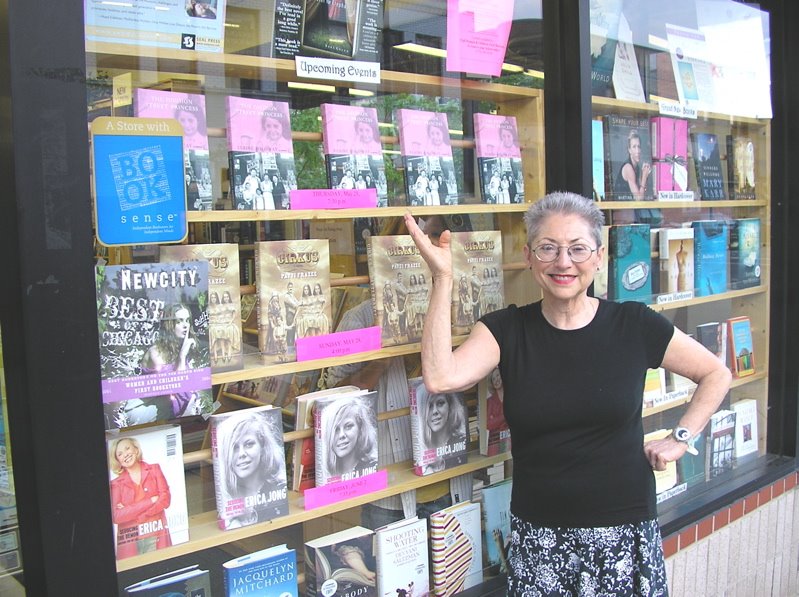
Postcript: The May 25th event at Chicago’s Women and Children First bookstore was a smash, with 100 people attending and 70 books sold. Watching and hearing my family and best friend as they joined me in reading passages from THE DIVISION STREET PRINCESS -- while outfitted in grocery store aprons -- was incredibly satisfying for me, and our terrific audience. Here are a few photos from the occasion; but if you want to view lots more (and spot yourself), check out http://web.mac.com/elainesoloway.


Left to right: cousin Neil Shapiro, brother Ron Shapiro, me, grandson Isaac Soloway-Strozier, daughters Jill and Faith Soloway, cousin Renee Elkin.

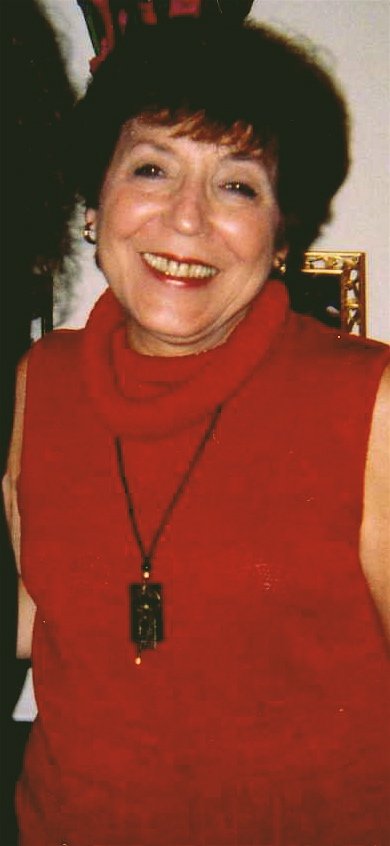
Best friend Ruth Gilbert.

A giant thank you to Felicia Dechter of Pioneer Press for the article that appeared in the Weds. May 24, 2006 issue:

Saturday, May 20, 2006

Happy 90th Birthday, Aunt Etta!


Today, May 20, 2006 is my Aunt Etta’s 90th birthday. To celebrate, I’ve gathered a few photographs to share, as well as an excerpt from THE DIVISION STREET PRINCESS.

Joining me in honoring my wonderful aunt, are Etta’s two children: David and Estherly
(and spouse Leonard Reifman), as well as Etta’s grandchildren Alan, Lynn (and spouse Jeff Richman), and Steve; and her great granddaughters Ari and Jordyn. Estherly describes her mother as, “caring, loving, smart, and thoughtful, with an amazing inner strength.” Those of us who know and love Etta couldn’t agree more, and we encourage you to leave your good wishes for this kind and compassionate woman in the Comment section at the end of this post. Your greetings will be shared with her as a special birthday surprise.

For background: Etta Elkin Kaplan, my mother’s younger sister by three years, is in many pages of my memoir, as is Estherly, who is one year younger than I. When we in lived on Division Street in the 1940s, all of the Elkins – including their spouses and children -- were close- knit. (We still are to this day.) Back then; we often counted on one another for support, companionship, and at times, food and housing.

There are many excerpts I could have selected that would have illustrated the love between my mom and her sister, as well as between Estherly and me.

The one I chose is from a chapter called “Searching for the Spotlight,” in which I describe my brother Ronnie’s Bar Mitzvah (58 years ago to the day!) and Estherly’s and my dance recital. This is poignant because it marks the time the Kaplans left Division Street for Chicago’s South Side (to be closer to Uncle Maury's butcher shop), and when the neighborhood itself was beginning to drift away.

But first, more photographs:

A surprised Aunt Etta, sometime in the 1940s or 50s.


A Division Street scene in the late 1940s. From left to right: me, my dad, my mom, Estherly, Etta, Rose Elkin Levy. In the front row, cousins David Kaplan, Jay Levy, and Norman Levy.


My Uncle Maury (another prominent character in my memoir) is pictured between his children David and Estherly.


The Elkin family passport in 1922 with six children who were born in Russia (two more were born in the U.S.) My mom, with the big eyes, age 9, is on the far left, and Etta, age 6 is front and center. (You can meet all of the Elkins in my book.)

And now, the excerpt:

“A few weeks before the recital, Aunt Etta and Estherly came to our store to meet Mom and me for our Saturday activities. The two sisters would be joining Molly and Rose for department store browsing, and my cousin and I would be off to final rehearsals.

That’s when Aunt Etta broke the news. ‘Maury found a place,’ she said. My mother remained silent. ’It’s a butcher shop in South Shore, and we’ll be renting a beautiful six-room apartment nearby. Maury can walk to work from the building.’

‘Are you moving’ I asked, turning from my aunt to my cousin. To myself I thought, no more Sunday rides together in Dad’s car? No more play-acting on the streetcar? No more dance lessons taken together?

As my cousin looked to her mother for an answer, my own mother found her voice. ‘I’m happy for you, Etta,’ she said, but her tone was serious like the time she challenged her father about the cost of Ronnie’s party. Then, she put her arms around her younger sister and said, ‘Six rooms? So Estherly and David will have their own bedrooms? You’ll have a dining room?’

Stepping back from her sister’s embrace, and taking both of my mother’s hands in hers, Aunt Etta said, ‘Wait and see, you’ll move from Division Street one day, too. You’ll get rid of the store. You’ll get a bigger apartment in a better neighborhood. Be happy for me; this is good for Maury, for our family. We’ll still meet downtown on Saturdays. We’ll still see each other, just not every day.’”


.

Sunday, May 14, 2006

The 47th Street Goddess


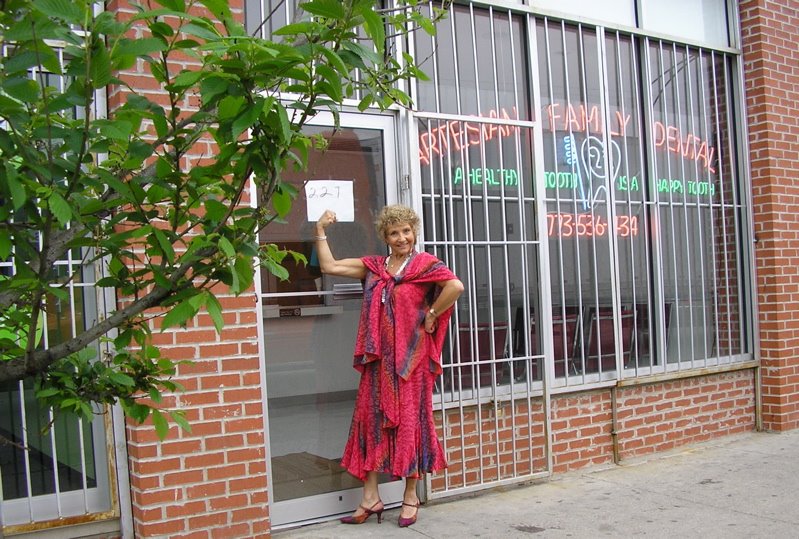
With her wildly printed silk ensembles, strappy high heels, and blonde coiffure, Hedy Ratner has come a long way from the 12-year-old girl who once worked at her family grocery store at 227 E. 47th St. in Chicago’s Kenwood neighborhood.

The muscles Hedy is flouting in a recent photo taken at the old location, first sprouted in the 1940s when Hedy helped her dad Joe and mom Rose in the store. “Unloading daily deliveries of meat and produce from vendors’ trucks,” Hedy claims was the regular exercise responsible for birthing those biceps.

“My dad was proud of those muscles,” Hedy recalled. “He bragged about them to all of our customers.” The Ratners held onto Joe’s Grocery for more than a decade until supermarkets (the same culprit responsible for the demise of my family store) invaded the neighborhood.

Hedy, 65, is now co-president of the Women’s Business Development Center (WBDC), which is celebrating its 20th anniversary this year. She says her entrepreneurial spirit was first sparked at Joe’s Grocery, and by her dad’s memorable words, “I’d rather clean toilets than work for someone else.”

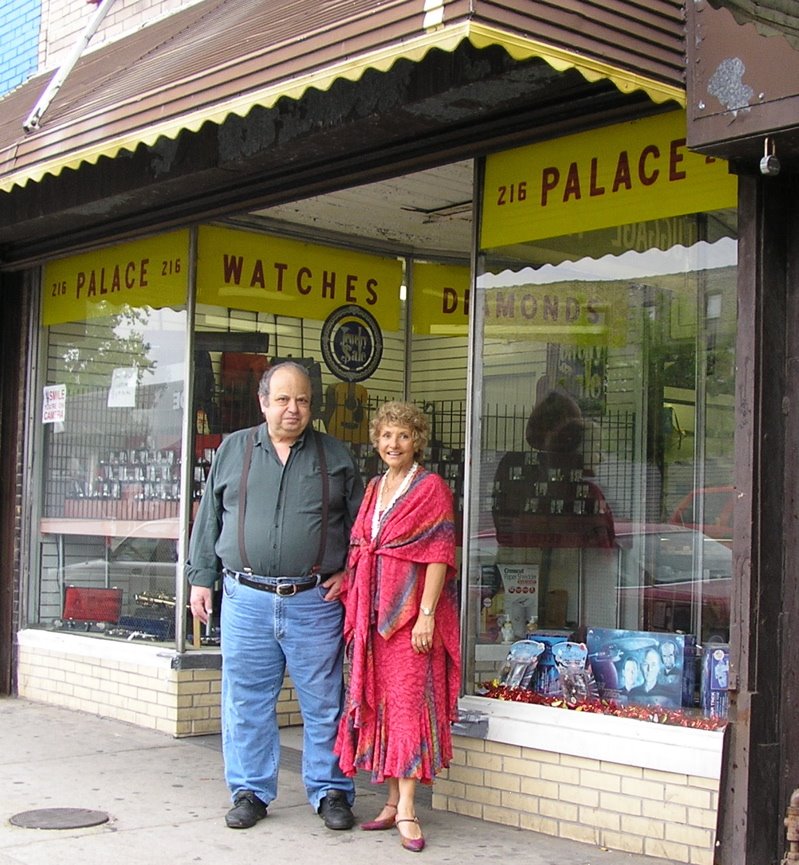
While on tour of Hedy’s old neighborhood, we stopped in at Palace Loan Co. where Hedy was delighted to find her old pal and fellow South Shore high school alum, Dave Lowis, manning the counter. Founded in 1918, the Lowis family has operated this shop that Hedy retreated to when things got boring at her grocery store across the street.

Hedy and I first met in 1980 when I was a press aide for Mayor Jane Byrne and Hedy was trying to get the City interested in her film studio project (that’s a whole other story). I was immediately dazzled, we became fast friends, she became a quasi role model for my brazen daughters Faith and Jill, and I have acted as occasional writer (most recently, the 20th Anniversary and 2005 Annual Report) and P.R. consultant to the WBDC.

The coincidence of both of us being grocery store kinderlach only makes our longtime friendship absolutely natural and enduring.

Monday, May 08, 2006

Neither rain nor sleet


Meet Joanne Samuels and Zeta Horton-Tyler, two outstanding representatives of the U.S. Postal Service who are pictured at my neighborhood Daniel J. Doffyn Station on N. Kedzie Avenue. These women have enthusiastically helped me mail copies of THE DIVISION STREET PRINCESS to addresses throughout the U.S. and internationally.

Thinking about the postal service sparks this excerpt from THE DIVISION STREET PRINCESS:

“Summer days on Division Street children claimed our concrete playing field, but by early evenings, we’d relinquish a portion to our parents. The sidewalk in front of our store was the customary gathering spot. And since our block was made up of six- and twelve-flat apartment buildings -- absent of porches or stoops -- the adults, like their creative children, improvised.

‘Here, put them here,' Mrs. Levinson said to her husband Saul one evening that July, as she pointed to a spot to the right of our grocery’s front door. Rose Levinson was the apple of her husband’s eye, as well as of her three sons. Mr. Levinson, bulky as my dad, was schlepping four metal card chairs -- two for his wife and him, the others reserved for my parents.

On that evening, the Friedmans and the Rosenbergs soon joined the Levinsons on the sidewalk. Each newcomer carried a card chair that squeaked as it was unfolded. These were the same chairs that were stored flat in a hall closet, then opened weekly for rounds of Pinochle and Gin Rummy, or Canasta and Kalukee. This night, as our neighbors settled in on their metal chairs, the men unbuttoned shirt collars and lit unfiltered cigarettes, and the women fixed their eyes on their wild kinderlach on the concrete stage before them.

A few of the men, including my father, shunned chitchat and folded damp arms under heads, and leaned back against the brick building. Subdued by a day of labor, several helpings of heavy Jewish cooking, and gasoline fumes from the street, they schloffed. Nothing could rouse our dozing fathers -- neither the screams of their flying children, nor the sounds of radio programs that leaked from open windows overhead. The crackley broadcasts of The Goldbergs or The Jack Benny Show, with their familiar characters and easy going plots, lulled -- rather than disturbed -- the drained men.

This particular evening, my mother was unfolding a flimsy blue envelope and reading news of her four brothers who were stationed overseas. ‘Listen,’ she said, pulling on her girlfriend’s bare arm to catch her attention. ‘You’ll never believe what my brother Nate did. He’s in the Army Engineers, you know.’ Then, she smoothed the airmail letter in her lap and read, ‘One of my pals told me he had seen a guy named Elkin in a military hospital, and that the soldier had malaria. I figured it was our brother Carl, because I hadn’t heard from him in a few weeks.’ As my mother continued Uncle Nate’s airmail, Mrs. Levinson’s eyes darted from my mother’s face to her kids’-- as if she was watching a tennis match at Humboldt Park. When the ball returned to Mom’s court, she read on, 'So I went AWOL until I found Carl. The docs said he’s okay, just resting up till they send him home. But guess where I am?' Mother paused here for dramatic effect. When Mrs. Levinson failed a guess, Mom read, in a loud voice mixed with humor and surprise, ‘In the brig! I have to serve seven days, one for each day I was gone from my outfit.’”

Thursday, May 04, 2006

The Princess and the Pool Room


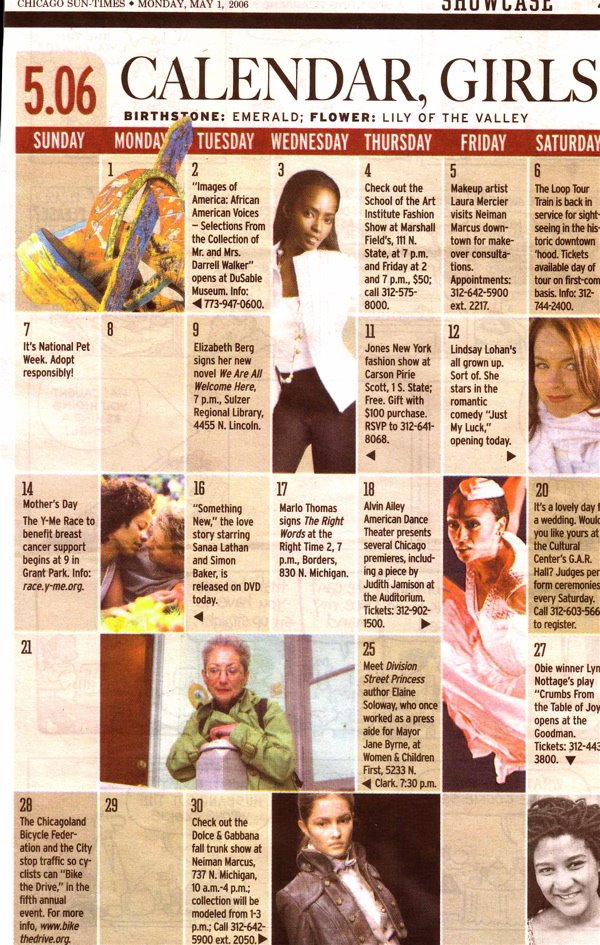
I was delighted to find me and The Division Street Princess as a sort of centerfold in the May 1, “Calendar, Girls” section of the Chicago Sun-Times. Of course, this calendar was nothing like the calendars of my childhood, especially the ones hanging on the walls of my dad’s favorite hangout, the neighborhood pool room. Here’s a few passages about that pool room that I’ve excerpted from my memoir:

"I never willingly entered the place, but occasionally Mom would ask me to go there and bring Dad home for supper. It wasn't the other men who hung out at the place that I was shy about, guys who rumpled my head like my young uncles who joined Dad for pool or cards before they were drafted, or the other men whom I knew from the neighborhood.

The disturbing part about the pool room were the Varga Girl calendars tacked on every wall. These pictures of blonde-haired beauties, with torsos that stretched from the top of the calendar to the page of the month, pulled my eyes towards them the moment I entered the smoke-filled room. Although Miss February might dangle a sheer scarf from a manicured hand, or Miss July would use a wide-brimmed hat to mask her anatomy, my youthful eyes would be dragged to the perfect breasts of these painted ladies.

'It’s my princess. One minute, one minute, sweetheart. Let me finish the hand.' the sound of Dad’s voice had broken the calendars’ hold and I took a seat at an empty card table, pushed away a butt-filled ashtray, and waited. My dad was wearing a short sleeve white shirt, his bloodied butcher’s apron abandoned in the store. His left arm was oddly tanned, fingers to elbow, a weird stain from hanging his arm out the window on Sunday drives.

Like he did at home; here at his spot in the pool room, Dad had unclasped his belt buckle, released his pants’ zipper and pushed his card chair a few inches from the table’s edge. The pool room smelled stale, damp, and smoky; and it was loud. A radio dial was turned to the baseball scores and met by occasional shouts of, 'Those momsers [bastards]!' I could hear calls of 'Gin!' -- and the slap of playing cards against the metal tables, and the pings of billiard balls as they batted into each other. Someone whose Poker hand had just been bested, let out 'Son-of-a-bitch!' then halted in mid-air as he glanced in my direction. 'Oh, sorry, honey, forgive my big mouth,' he had said.

Finally, Dad had zipped up his trousers, buckled the belt, scooped a handful of coins from the middle of the card table into his pocket and rose from his seat. 'Okay, Princess, let’s go home,' he had said, lifting my hand to his lips for a kiss, then sealing the same hand into his moist palm."

Sunday, April 30, 2006

Baldacci, Black, Gilbert, and Soloway at Roosevelt U.


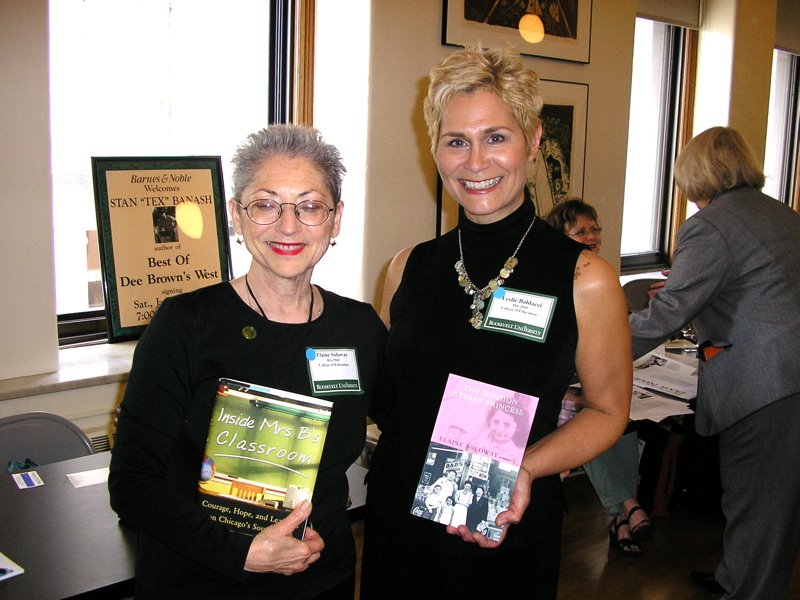
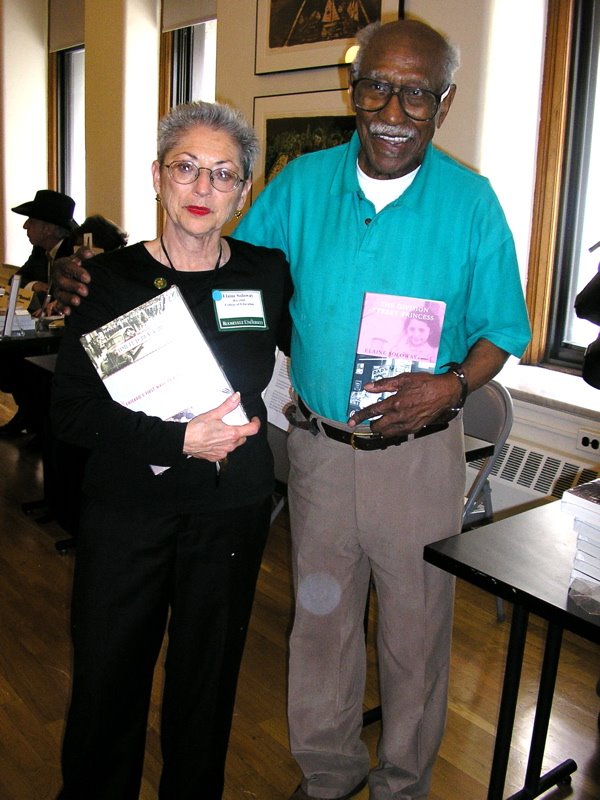
On April 28, 2006, The Division Street Princess and I joined 36 other authors and their books at Roosevelt University’s Alumni-Faculty Authors Forum. Prominent Chicagoans Leslie Baldacci, Inside Mrs. B.’s Classroom, Courage, Hope and Learning on Chicago’s South Side, and Timuel Black, Bridges of Memory, kindly posed for photographs and switched books with me for variety.

And Ruth Ross Gilbert, my dear friend and Roosevelt U. alumnus, was also at my side at the Forum, just as she is in several pages of The Division Street Princess.

Enjoy the pictures – even those where my eyes are closed in that pairing with beautiful Leslie B. And that's my Ruthie, to the left.

Tuesday, April 25, 2006

The Modern Jewish Girl's Guide to Guilt


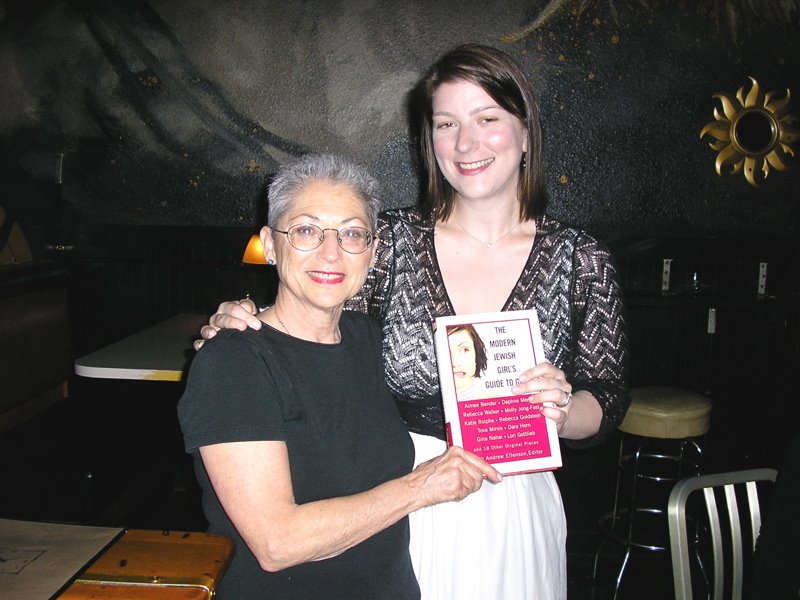
That's me with Ruth Andrew Ellenson, Editor of The Modern Jewish Girl's Guide to Guilt (Dutton, 2005). On April 24, Ruthie signed and read from her terrific anthology, which has been correctly described as "a hilarious, surprising, moving, and thoughful book that captures all that is complicated and wonderful about being a Jewish woman today." The event at Matilda's on N. Sheffield, was sponsored by The Hillels of Illinois, which is supported by the Jewish United Fund/Jewish Federation of Metropolitan Chicago. Hillel helps Jewish students and young adults "encounter, explore, and express their identity as Jews." If you buy Ruthie's book, and mine, you'll get an eye-opening view of Jewish women, from way back in the 1940s to present day. Enjoy...

Tuesday, April 18, 2006

Mother's Day Circa 1948


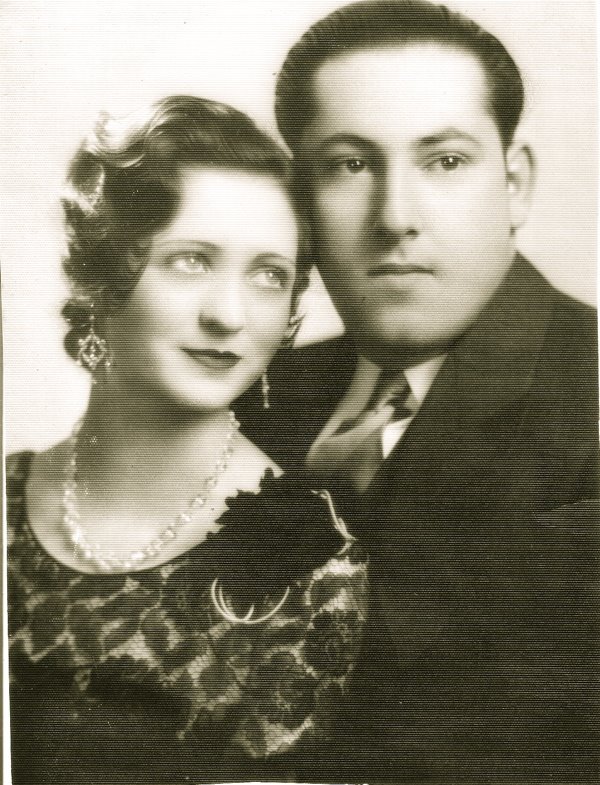
THE DIVISION STREET PRINCESS will be available for purchase in time for Mother's Day, May 14! Links to booksellers are on the side of this page. To entice you to consider the memoir as a gift for your favorite mother, daughter, sister, spouse, partner, I'm including an excerpt from the book, and my parent's engagement photo. A mother's day rememberence, circa 1948, follows.

"Mom, outfitted in a gray silk shantung dress that shimmered with each of her high-heeled steps, kept her gloved hands tight on her pocketbook. With her black felt hat and veil (the “rooftops of Paris look”), Mother was the unquestionable beauty of the bunch.

She was also wearing the dark mink stole that Dad had given her the Sunday before, on Mother’s Day. Although his gift had initially caused a flare-up, I was happy to see that she had relented and would be entering the synagogue embraced in the soft fur.

The present that Ronnie and I had given her caused no problem, only delight as she unwrapped the blue leather jewelry box. My brother and I had pooled our savings to swing the $3 gift and smiled proudly as she proclaimed, “It’s perfect! I’ll put my pearls here, my earrings here, and my broaches here.” She was pointing to the box’s felt compartments, and I pictured her costume jewelry, suffused with the smells of her cosmetics and perfume, nestled happily in their new homes.

When Dad had placed a large silver box before her, his face was bright with excitement and likely greedy for a reaction one hundred times greater than the one granted our jewelry case. Mom opened the lid of Dad’s gift, removed the white paper, and lifted out the beautiful mink stole. “Irv, you know we can’t afford this,” she had said, and slowly replaced the mink in its tissue nest. “We have so many bills…”
“I bought it on time,” Dad had said, and reached deep into the silver box to retrieve the stole. “Just try it on. You’ll look gorgeous in it.” He held the mink stretched out between his two pudgy hands, smiling like a wholesale furrier flattering a dubious client. “You deserve a mink. And I’ll pay it off. Don’t worry. Just try it on.”

“Please try it on,” Ronnie and I had pleaded. At the time, I was just a little girl who adored her father and couldn’t bear his disappointment. I could not have appreciated my mother’s struggle to keep us afloat, and saw her only as an ungrateful wife who had crushed my father as surely as a runaway truck. I remember thinking to myself, Just take it, Mom, for Daddy’s sake. Just take it.

And once my mother had placed the lovely fur around her thin shoulders, and considered her stylish reflection in the bedroom mirror above the dresser -- perhaps imagining herself in the spotlight like Barbara Stanwyck in Double Indemnity -- she agreed to keep the stole and monitor Dad’s monthly installments."

Friday, April 14, 2006

Mark Your Calendars

FOR IMMEDIATE RELEASE Contact:
Elaine Soloway
773-478-1351 (phone)
773-220-4606 (mobile)
elainesoloway@sbcglobal.net
http://thedivisionstreetprincess.blogspot.com


1940’s CHICAGO MEMOIR AT WOMEN & CHILDREN FIRST
"The Division Street Princess" Reading and Signing Set for May 25

WHAT: Elaine Soloway, formerly press aide to Mayor Jane Byrne and School Superintendent Ruth Love, has authored a memoir, THE DIVISION STREET PRINCESS -- a coming of age story of a girl, a store, and a vibrant immigrant Chicago neighborhood.

Set in the 1940s, Soloway's memoir takes it title from the street where she lived in a three-room flat above her family's grocery store and from the pet name her father gave her. In her poignant tale of bookies, poolrooms, sidewalk playgrounds, and relatives who lived down the block, we also learn about the underside of childhood and urban life.

WHEN: 7:30 p.m., Thursday, May 25, 2006; free

WHERE: Women & Children First bookstore, 5233 N. Clark St., Chicago

WHO: Joining Soloway for the book reading and signing will be her daughters, Faith and Jill Soloway, who began their show business careers at Chicago's Annoyance Theatre with THE REAL LIVE BRADY BUNCH. Currently, Faith is a musician and producer of rock operas in Boston; and Jill, who lives in Los Angeles, was a writer on the HBO series "Six Feet Under" and is the author of TINY LADIES IN SHINY PANTS.

Elaine Soloway is a public relations consultant and freelance writer whose essays have appeared in many print and online publications including New York Times Money & Business, Chicago Tribune WomenNews, Chicago Jewish News, FreshYarn.com and others. Her long career in public relations has focused on housing, healthcare, and economic development.

Soloway, who holds a bachelor’s degree in education from Roosevelt University and a master’s degree in urban planning from the University of Illinois Chicago, lives in Chicago’s Irving Park neighborhood with her husband, Tom, and golden retriever, Buddy.
###

Monday, April 10, 2006

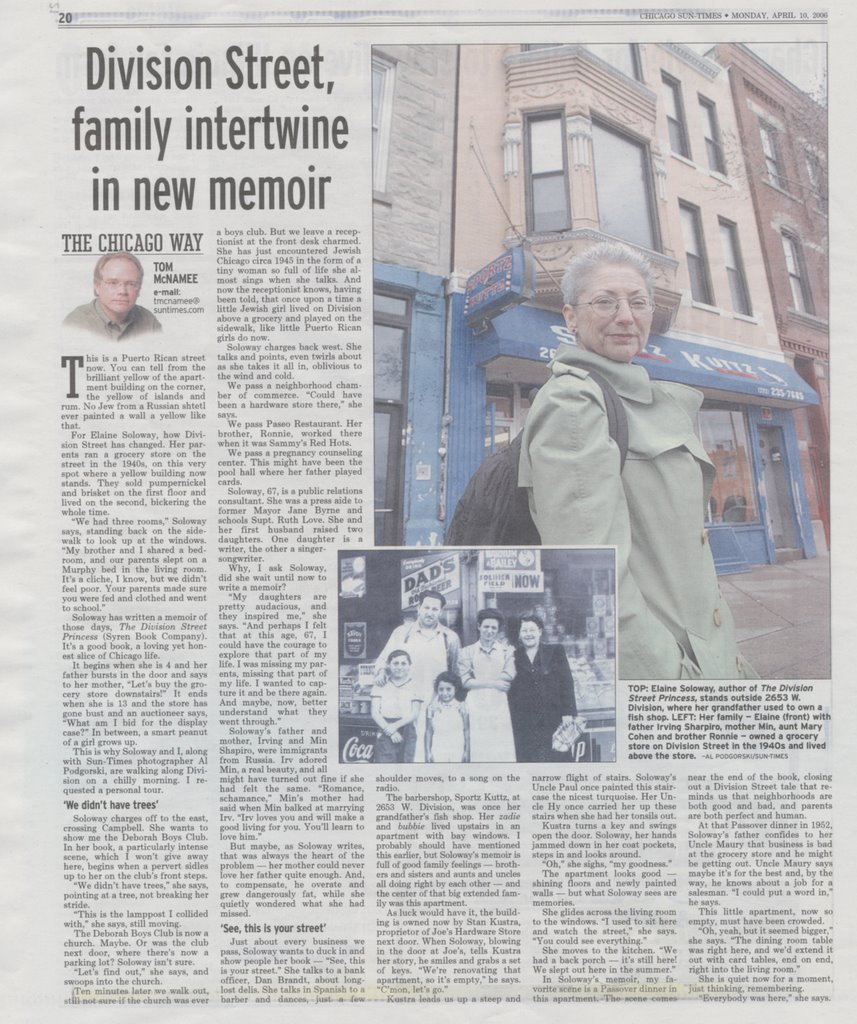
Sun-Times, April 10, 2006. Yea!

Tom McNamee
Division Street, family intertwine in new memoir

April 10, 2006

BY TOM McNAMEE SUN-TIMES COLUMNIST


This is a Puerto Rican street now. You can tell from the brilliant yellow of the apartment building on the corner, the yellow of islands and rum. No Jew from a Russian shtetl ever painted a wall a yellow like that.

For Elaine Soloway, how Division Street has changed. Her parents ran a grocery store on the street in the 1940s, on this very spot where a yellow building now stands. They sold pumpernickel and brisket on the first floor and lived on the second, bickering the whole time.

"We had three rooms," Soloway says, standing back on the sidewalk to look up at the windows. "My brother and I shared a bedroom, and our parents slept on a Murphy bed in the living room. It's a cliche, I know, but we didn't feel poor. Your parents made sure you were fed and clothed and went to school."

Soloway has written a memoir of those days, The Division Street Princess (Syren Book Company). It's a good book, a loving yet honest slice of Chicago life.

It begins when she is 4 and her father bursts in the door and says to her mother, "Let's buy the grocery store downstairs!" It ends when she is 13 and the store has gone bust and an auctioneer says, "What am I bid for the display case?" In between, a smart peanut of a girl grows up.

This is why Soloway and I, along with Sun-Times photographer Al Podgorski, are walking along Division on a chilly morning. I requested a personal tour.

'We didn't have trees'

Soloway charges off to the east, crossing Campbell. She wants to show me the Deborah Boys Club. In her book, a particularly intense scene, which I won't give away here, begins when a pervert sidles up to her on the club's front steps.

"We didn't have trees," she says, pointing at a tree, not breaking her stride.

"This is the lamppost I collided with," she says, still moving.

The Deborah Boys Club is now a church. Maybe. Or was the club next door, where there's now a parking lot? Soloway isn't sure.

"Let's find out," she says, and swoops into the church.

Ten minutes later we walk out, still not sure if the church was ever a boys club. But we leave a receptionist at the front desk charmed. She has just encountered Jewish Chicago circa 1945 in the form of a tiny woman so full of life she almost sings when she talks. And now the receptionist knows, having been told, that once upon a time a little Jewish girl lived on Division above a grocery and played on the sidewalk, like little Puerto Rican girls do now.

Soloway charges back west. She talks and points, even twirls about as she takes it all in, oblivious to the wind and cold.

We pass a neighborhood chamber of commerce. "Could have been a hardware store there," she says.

We pass Paseo Restaurant. Her brother, Ronnie, worked there when it was Sammy's Red Hots.

We pass a pregnancy counseling center. This might have been the pool hall where her father played cards.

Soloway, 67, is a public relations consultant. She was a press aide to former Mayor Jane Byrne and schools Supt. Ruth Love. She and her first husband raised two daughters. One daughter is a writer, the other a singer-songwriter.

Why, I ask Soloway, did she wait until now to write a memoir?

"My daughters are pretty audacious, and they inspired me," she says. "And perhaps I felt that at this age, 67, I could have the courage to explore that part of my life. I was missing my parents, missing that part of my life. I wanted to capture it and be there again. And maybe, now, better understand what they went through."

Soloway's father and mother, Irving and Min Shapiro, were immigrants from Russia. Irv adored Min, a real beauty, and all might have turned out fine if she had felt the same. "Romance, schamance," Min's mother had said when Min balked at marrying Irv. "Irv loves you and will make a good living for you. You'll learn to love him."

But maybe, as Soloway writes, that was always the heart of the problem -- her mother could never love her father quite enough. And, to compensate, he overate and grew dangerously fat, while she quietly wondered what she had missed.

'See, this is your street'

Just about every business we pass, Soloway wants to duck in and show people her book -- "See, this is your street." She talks to a bank officer, Dan Brandt, about long-lost delis. She talks in Spanish to a barber and dances, just a few shoulder moves, to a song on the radio.

The barbershop, Sportz Kuttz, at 2653 W. Division, was once her grandfather's fish shop. Her zadie and bubbie lived upstairs in an apartment with bay windows. I probably should have mentioned this earlier, but Soloway's memoir is full of good family feelings -- brothers and sisters and aunts and uncles all doing right by each other -- and the center of that big extended family was this apartment.

As luck would have it, the building is owned now by Stan Kustra, proprietor of Joe's Hardware Store next door. When Soloway, blowing in the door at Joe's, tells Kustra her story, he smiles and grabs a set of keys. "We're renovating that apartment, so it's empty," he says. "C'mon, let's go."

Kustra leads us up a steep and narrow flight of stairs. Soloway's Uncle Paul once painted this staircase the nicest turquoise. Her Uncle Hy once carried her up these stairs when she had her tonsils out.

Kustra turns a key and swings open the door. Soloway, her hands jammed down in her coat pockets, steps in and looks around.

"Oh," she sighs, "my goodness."

The apartment looks good -- shining floors and newly painted walls -- but what Soloway sees are memories.

She glides across the living room to the windows. "I used to sit here and watch the street," she says. "You could see everything."

She moves to the kitchen. "We had a back porch -- it's still here! We slept out here in the summer."

In Soloway's memoir, my favorite scene is a Passover dinner in this apartment. The scene comes near the end of the book, closing out a Division Street tale that reminds us that neighborhoods are both good and bad, and parents are both perfect and human.

At that Passover dinner in 1952, Soloway's father confides to her Uncle Maury that business is bad at the grocery store and he might be getting out. Uncle Maury says maybe it's for the best and, by the way, he knows about a job for a salesman. "I could put a word in," he says.

This little apartment, now so empty, must have been crowded.

"Oh, yeah, but it seemed bigger," she says. "The dining room table was right here, and we'd extend it out with card tables, end on end, right into the living room."

She is quiet now for a moment, just thinking, remembering.

"Everybody was here," she says.
Tuesday, April 04, 2006


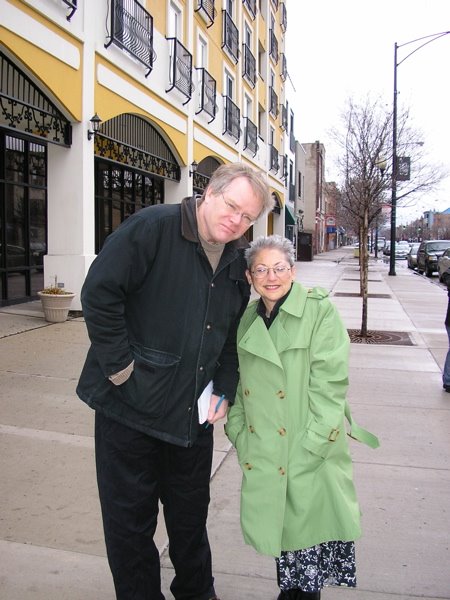
Tom McNamee and I are pictured in front of a five-story seniors building at 2501-11 W. Division St. It was developed by the Hispanic Housing Development Corp. to serve low- and moderate-income residents of West Town and Humboldt Park. In the 1940's, my family's grocery store, and the apartment building that housed our three-room flat, stood on this very same site.(Story due in the Chicago Sun-Times, Monday, April 10, 2006.)

Division Street is being revitalized and I think my folks would be pleased to see how this new group of immigrants are enjoying the gateway to the American dream -- just as they and their families did so many decades ago.

The highpoint of the tour was a walk through my grandparents' apartment at 2653 W. Division St. My zadie's fish store is now a hip-hop barber shop and the apartment above the store is being renovated with new stained wood floors and a brick fireplace. The bay windows remain and I recall standing at those windows staring out at my Division Street landscape. Our last Passover meal on Division Street was in this very apartment. You can read details of that evening in my book.

Monday, March 06, 2006

The Division Street Princess
Publication Month: May, 2006
Author: Elaine Soloway
Syren Book Company
Available for preorder at your favorite bookstore.


NEWS RELEASE
FORMER MAYORAL PRESS AIDE PENS MEMOIR OF 1940’S CHICAGO CHILDHOOD
Elaine Soloway’s The Division Street Princess Tells of Old Neighborhood,
A Chapter Describes Horrific 1946 Murder and its Affect on Author


Elaine Soloway, formerly press aide to Mayor Jane Byrne and communications director for School Superintendent Ruth Love, has authored a memoir, The Division Street Princess -- a coming-of-age story of a girl, a store, and an immigrant Chicago neighborhood.

Set in the 1940s, Soloway’s memoir takes its title from the street where she lived in a three-room flat above her family’s grocery store and from the pet name her father gave her. In her tale of bookies, poolrooms, sidewalk playgrounds, and relatives who lived down the block, we learn about her embattled parents, adored older brother, and neighborhood kibitzers.

Along with her recollections and historical photographs of a vibrant old neighborhood, she also shows the underside of childhood and urban life. Although far from the Holocaust and the war overseas, Soloway faced dangers close to home. When six-year-old Suzanne Degnan is murdered (William Heirens, who was convicted of the crime, remains in prison today), the offense and the city’s lurid newspaper coverage traumatized Soloway, as does a more personal experience that same year.

As Soloway struggled to find her own identity, the family store and Division Street waged battles too: for post-war prosperity, television, supermarkets, and suburbia threatened an end to corner stores—and to old neighborhoods everywhere.

Elaine Soloway is a public relations consultant and freelance writer whose essays have appeared in many publications including New York Times Money & Business, Chicago Tribune WomanNews, Chicago Jewish News, and others. Her long career in public relations has focused on housing, health care, and economic development.

Soloway lives in Chicago’s Irving Park neighborhood with her husband Tom and golden retriever Buddy, and has two daughters and two grandchildren. Both daughters began their careers in the Chicago theatre scene and are in the entertainment industry: Faith is a musician and producer of rock operas who also works in a violence prevention program with the Boston public schools. Jill lives in Los Angeles and was a writer on the HBO series, “Six Feet Under,” and is the author of Tiny Ladies in Shiny Pants (Free Press).

Elaine Soloway can be reached at 773-478-1351 or elainesoloway@sbcglobal.net.

-30-